Training Doesn't Change You. Testing It Does.
What cycling 105 miles with 17,700 feet of climbing over eleven and a half hours in the French Alps taught me about capability, belief, and business.
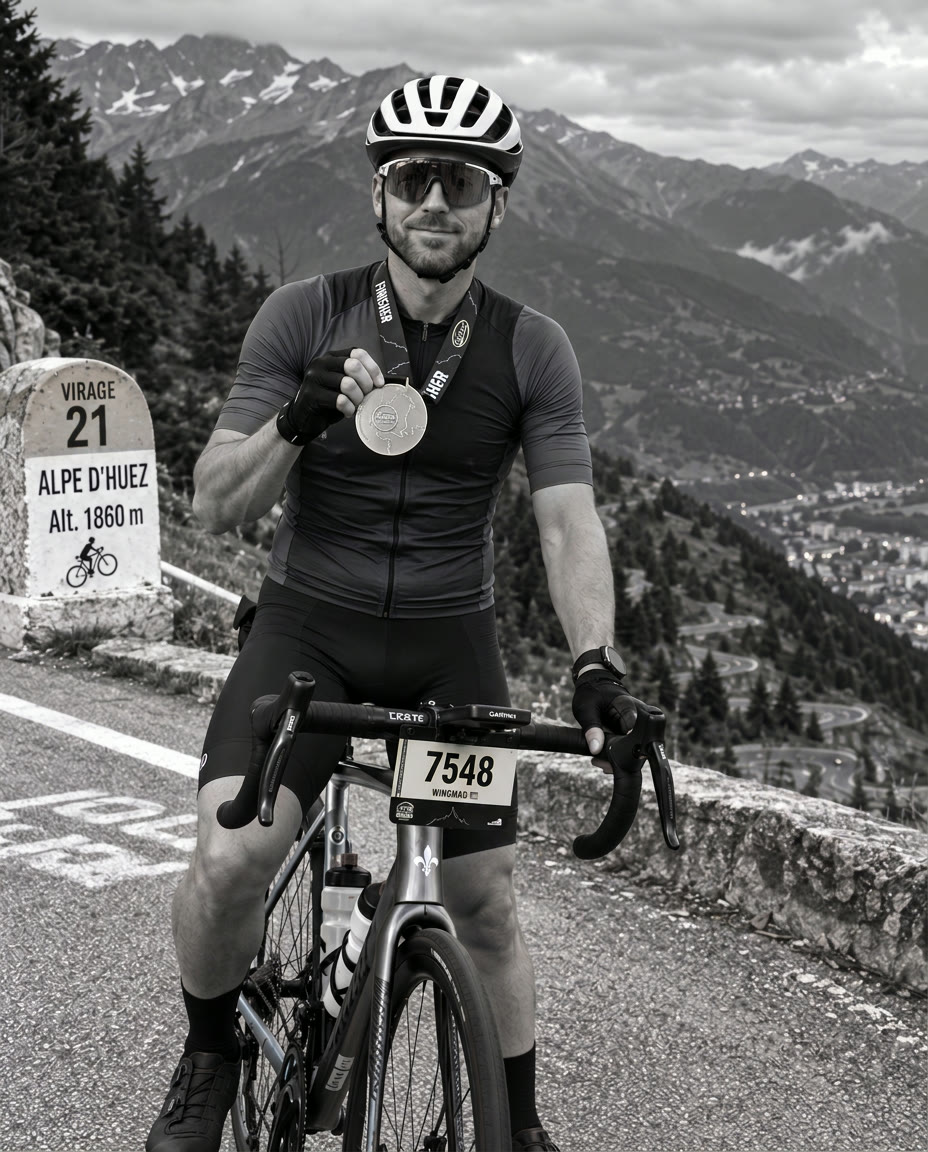
In July, I went to France to ride my first bike race.
That sentence leaves out quite a bit.
I had never raced a bike before. I had never ridden a bike in another country. I was one of relatively few Americans in a field made up largely of European riders.
And for my first race, I'd chosen L'Étape du Tour de France.
For anyone outside cycling, that requires some explanation. Created in 1993, L'Étape gives amateur cyclists the chance to ride a mountain stage of the Tour de France under conditions built to feel as close to the real thing as possible: closed roads, thousands of riders starting in waves, timed results, cutoffs, aid stations and, most importantly, the same mountains the professionals ride.
In 2026, roughly 15,000 riders from 79 countries gathered in the French Alps to ride from Le Bourg-d'Oisans to Alpe d'Huez, about 105 miles with 5,400 meters, nearly 17,700 feet, of climbing. The route crossed the Col de la Croix de Fer, the Col du Télégraphe, the Col du Galibier and the Col de Sarenne before finishing at Alpe d'Huez.
This wasn't just any stage, either. We were riding the exact route that would become Stage 20 of the 2026 Tour de France six days later: the queen stage, the hardest day of that year's race. Cycling publications called the professional version one of the hardest stages in Tour history. Afterward, the organizers said ours was the most demanding course L'Étape had ever offered.
So naturally, I decided this would be a good place to try bike racing for the first time.
105 Miles Doesn't Really Describe It
I'd ridden century rides before, which gave me some confidence going in. But distance wasn't what made this race hard. The climbing was.
First the Croix de Fer. Then the Télégraphe. Then the Galibier, topping out above 8,600 feet. Then the Sarenne, and the long final approach to Alpe d'Huez. For long stretches, the day was really just a choice between climbing and descending.
Unlike the professionals, I wasn't trying to win anything. My goal was simpler: finish.
The organizers gave riders 11 hours and 45 minutes to reach the line. Miss a cutoff point along the way, and your race is over, which changes the psychology of the whole day. You aren't just riding until you're done. The clock is always somewhere in the background.
And over eleven-plus hours, a lot can happen. For me, it did. I flatted. I had problems with my chain.
Written down, those don't sound dramatic. They're ordinary cycling problems. But when you've flown to another country, spent months preparing for one event, and you're already trying to cover 105 miles and 17,700 feet of climbing before a cutoff, small problems stop feeling small. Every delay costs time. Every stop breaks your rhythm. And every problem raises a question you'd rather not sit with: Am I still going to finish this?
So I fixed what I could and kept moving.
Eleven and a Half Hours
Eventually the field thinned. The excitement of the start line was long gone, and so were my fresh legs.
By the time I reached the final major climb, I'd been on the bike most of the day. This is the part I remember differently from everything before it. It wasn't primarily physical anymore. I was tired, extremely tired, but the real challenge had moved somewhere else. It had become mental.
I found myself negotiating with myself in a way I don't think I ever had before. I knew the finish existed somewhere ahead. I also knew the only way to get there was to keep turning the pedals. There was no sudden reserve of energy waiting to appear. No training plan that could help me now. No one who could make the decision for me.
At some point the question got remarkably simple: Are you going to keep going?
Looking back, I think that final climb was the biggest mental test of my life, not because anything catastrophic happened, but because nothing did. The mountain didn't care that I'd trained. It didn't care how far I'd already ridden, that I was exhausted, that I'd dealt with a flat and a bad chain, or that I'd flown across an ocean to be there. The road just kept going up, and I had to keep deciding, over and over, to go up with it.
I crossed the finish line after roughly eleven and a half hours.
I finished.
The Race Didn't Make Me Capable
I've thought a lot about that day since coming home. For a while I assumed the lesson would be something about perseverance: don't quit, keep going, hard things are possible. All true. None of it quite captured what actually stayed with me.
The more interesting realization was this: the race didn't make me capable of finishing the race. The training had already done that. The long rides had done it. The climbing had done it. The days I trained even when I didn't feel like it had done it. The fitness was already there when I landed in France.
What the race gave me was something different: evidence.
Training built the capability. The race forced me to trust it.
I think that distinction matters well beyond cycling.
Capability Can Grow Faster Than Identity
I've spent much of my career building a business, and one of the strange things about doing anything for a long time is that change often happens too gradually to notice. You learn. You make mistakes. You develop better judgment. You start solving problems you wouldn't have known how to touch five years earlier. You work with more complicated organizations, survive bad decisions, and make better ones.
The business gets more capable. You get more capable. But your sense of yourself doesn't always update at the same speed.
I've started calling this an identity lag.
You can become stronger before you think of yourself as strong. You can build real expertise while still privately thinking of yourself as someone figuring it all out. A company can grow considerably more sophisticated while continuing to behave, internally, like the smaller company it used to be.
That lag shows up in decisions. You underprice the work. You defer when your own experience says you should push back. You keep hunting for one more piece of validation. You prepare, and prepare, and prepare, sometimes long after you were actually ready.
Preparation Can Become a Hiding Place
This is especially easy to fall into in business, because preparation looks productive. Rewrite the website. Refine the positioning. Study the competition. Build another process. Take another course. Wait for one more case study.
Most of that is genuinely useful. I do plenty of it myself. But I've come to recognize a point where preparation stops being preparation and starts being protection, because the safest place for an idea is always before you've tested it.
A strategy you haven't implemented can't fail. A point of view you haven't stated publicly can't be rejected. A price you haven't quoted can't be challenged. An opportunity you never pursue can never expose whether you were ready for it.
Training is controlled. The race isn't.
Being Helpful Isn't Always the Same as Being Useful
I've noticed a version of this in my own work, too. For a long time, I equated being good at my job with being agreeable: listen carefully, be responsive, deliver what's asked, keep the client happy. There's nothing wrong with any of that.
But experience eventually creates a responsibility that agreeableness doesn't satisfy. Sometimes the most useful thing I can do is disagree. Sometimes I need to tell a client that what they're asking for isn't actually the problem. Sometimes my job isn't to execute the idea in front of me. It's to challenge it.
And the hard part usually isn't knowing what I think. It's trusting that I've earned the right to say it.
That's where France keeps coming back to me. The preparation had already happened. The only open question was whether I trusted it enough to act on it.
Evidence Changes the Story
Before L'Étape, I could look at my training and reasonably assume I was capable of finishing the race. After L'Étape, none of that was theoretical anymore. I had ridden 105 miles through the French Alps. I had climbed roughly 17,700 vertical feet. I had dealt with a flat and a broken chain. I had reached the point where finishing became more mental than physical, and eleven and a half hours in, I'd crossed the line anyway.
That evidence changed something in me.
Businesses collect evidence too. A hard engagement proves your team can solve a certain kind of problem. A strategy that works proves your thinking survives contact with reality. Landing a bigger client resets your sense of who you're able to serve. A result you'd once have called exceptional eventually becomes something you know how to reproduce.
We usually think of that evidence as something we gather for other people: case studies, testimonials, proof points for a prospective customer to trust. But maybe we need it just as much. Because eventually, it should change how we see ourselves.
Finding the Starting Line
There's an obvious lesson here about endurance sports requiring preparation. I wouldn't recommend attempting L'Étape without it.
But that's not the lesson I actually brought home from France. Mine was this: preparation and belief are not the same thing. You can spend months becoming capable of something and still wonder, right up to the start line, whether you can actually do it. Eventually there's only one way to find out. You have to put the training to use.
There are moments in business when more preparation really is the right call. And there are other moments when the work is already done. The experience has accumulated, the judgment has sharpened, the capability is there. The only thing that hasn't caught up yet is the way you see yourself.
Sometimes the next step isn't another training ride.
It's finding the starting line.